Packing a kitchen is often the most daunting task of any relocation. It is the room where fragility meets volume, and where the sheer number of small, oddly shaped items can overwhelm even the most organized person. From heavy Dutch ovens to delicate crystal wine glasses, every item requires a specific approach to ensure it arrives at your new home in one piece. Unlike a bedroom or a living room, the kitchen is used until the very last minute, making it a logistical puzzle of what to pack and when.
At Moveshire, we have seen thousands of moves, and we know that the kitchen is consistently cited as the hardest room to pack. The combination of grease-prone surfaces, breakable ceramics, and expensive appliances creates a high-stakes environment. However, with a systematic approach and the right professional advice, you can transform this chaotic chore into a manageable process. This guide provides a comprehensive roadmap to help you pack your kitchen like a professional mover.

Why Packing Your Kitchen Is the Hardest Room to Move
The kitchen is the heart of the home, but for movers, it is the center of complexity. Several factors contribute to why this room takes the longest to pack and requires the most materials. First, there is the sheer diversity of items. You are not just packing books or clothes; you are dealing with liquids, sharp objects, heavy metals, and brittle glass. Each category requires a different wrapping technique and box strength.
Secondly, the kitchen contains many "hidden" items. Deep cabinets and high shelves often harbor gadgets and sets that have not been touched in years. This leads to a massive volume of goods that people often underestimate until they start pulling them out. Finally, the fragility of kitchenware means you cannot simply toss things into a box. Every plate, cup, and bowl needs individual attention. Moveshire's expertise shows that without a clear strategy, kitchen packing can take twice as long as any other room in the house. This guide is designed to cut that time in half while ensuring maximum safety for your belongings.
When To Pack Your Kitchen When Moving
Timing is everything when it comes to the kitchen. If you pack too early, you will be eating off paper plates for a month. If you pack too late, you will be rushing through fragile items on moving day, which leads to breakage. Following a tiered timeline is the best way to stay sane. For a broader overview of where the kitchen fits into your overall move, see our guide on what to pack first when moving.
4-6 Weeks Before: What to Do First
This is the "assessment and decluttering" phase. Start by going through the highest shelves and the deepest cupboards. At this stage, you should:
- sort through your "junk drawer" and discard expired coupons or broken rubber bands;
- identify appliances you only use once a year, such as turkey roasters or specialized holiday baking pans;
- evaluate your pantry and start planning meals around what you already have to reduce weight;
- inventory high-value items like fine china or silver that may require extra insurance or special crates.
1-2 Weeks Before: What Can Be Packed Early
Now is the time to pack things you can live without for a few days. This includes:
- the majority of your cookbooks and decorative kitchen items;
- extra sets of dishes and glassware that you do not use daily;
- specialty appliances like waffle makers, bread machines, or slow cookers;
- wine collections and barware, ensuring bottles are sealed and padded;
- outdoor grilling tools and picnic sets.
1-2 Days Before: What to Pack Last
As moving day approaches, narrow your kitchen down to the "survival essentials." Everything else goes into boxes:
- pack away the majority of your pots and pans, leaving just one or two multipurpose pieces;
- box up most of your cutlery, keeping one set per family member;
- clean and pack small appliances like the toaster or blender once they are no longer needed for breakfast;
- empty the pantry of non-perishables that are not part of your immediate meal plan.
Moving Day: What Stays Out Until the End
On the actual day of the move, you will pack your "essentials kit." This typically includes your coffee maker, a few rolls of paper towels, basic cleaning supplies, and the very last of your perishable snacks. These should be the last items onto the truck and the first items off.

What You'll Need: Kitchen Packing Supplies Checklist
You cannot pack a kitchen properly with just standard cardboard boxes and some old newspapers. Kitchen items are heavy and fragile, requiring reinforced materials. Using the wrong supplies is the primary cause of damage during transit.
Boxes (Sizes and Quantities)
You will need a variety of box types to handle the different weights and shapes in a kitchen. Not sure which sizes are most cost-effective? Our guide on small vs. large moving boxes breaks it down:
- heavy-duty small boxes for heavy items like canned goods or spices;
- medium boxes for most small appliances and pots and pans;
- dish barrels or "dish packs" which are double-walled and designed for fragile plates and glassware;
- large boxes only for very light, bulky items like plastic containers or dish racks.
Wrapping and Padding Materials
Do not skimp on padding. You will need:
- packing paper (newsprint) - buy this in large bundles rather than relying on old newspapers which can leave ink stains;
- bubble wrap for extremely delicate items like crystal or heirloom ceramics;
- corrugated cardboard dividers for glasses and bottles;
- stretch wrap to keep sets together or to secure appliance cords.
Labels, Markers, and Tape
Organization is key to an easy unpack. Ensure you have high-quality packing tape (avoid masking or duct tape), permanent markers in various colors, and "Fragile" or "This Side Up" stickers to alert the movers.
How Many Boxes Do You Need for a Kitchen?
While every kitchen is different, these are the standard estimates based on Moveshire's experience:
|
Kitchen Size |
Small Boxes (1.5 cu. ft.) |
Medium Boxes (3.0 cu. ft.) |
Dish Barrels |
Large Boxes (4.5 cu. ft.) |
|
Studio / One-Bedroom |
5-10 |
5-8 |
2-3 |
2 |
|
Medium Apartment |
10-15 |
10-12 |
4-5 |
3-4 |
|
Large House Kitchen |
20-25 |
15-20 |
8-10 |
5-6 |
How To Pack Up Your Kitchen: Getting Organized First
Before you put a single plate into a box, you need a strategy. Jumping straight into packing leads to disorganized boxes that are a nightmare to unpack later. Follow these steps to prepare your space.
Step 1: Declutter Before You Pack
Moving is the perfect time to purge. Be ruthless. If you have three spatulas and two are melting, throw them away. If you have a gadget you have not used since 2018-2020, donate it. Every item you get rid of is one less thing to wrap, carry, and pay to move. Check for chipped plates, mismatched Tupperware, and expired spices.
Step 2: Separate What You'll Use Until Moving Day
Identify a "last-out, first-in" set of items. This should include one plate, bowl, cup, and set of utensils for each family member. Include a dish sponge, a small bottle of dish soap, and two dish towels. Put these in a specific spot so they don't accidentally get packed in a random box.
Step 3: Reduce Pantry and Fridge Contents
In the weeks leading up to the move, try to "eat down" your pantry. Canned goods are incredibly heavy and expensive to move. Avoid buying new groceries and get creative with the ingredients you have. If you have leftover perishables on moving day, offer them to neighbors or use a service like "Move for Hunger."
Step 4: Sort Out Hazardous or Non-Packable Items
Movers are legally restricted from carrying certain kitchen items. This includes pressurized cans (like cooking spray), flammable liquids (like high-proof alcohol or cleaning chemicals), and open food containers that could attract pests. Make a plan to transport these in your own car or dispose of them safely.
Step 5: Clean and Dry Everything Before Boxing
Packing a dirty dish is a recipe for mold and unpleasant smells. Ensure every pot, pan, and plate is completely dry. Moisture trapped in a box can weaken the cardboard and cause it to collapse. Additionally, wipe down the exteriors of condiment bottles if you plan to move them, as sticky residues can ruin other items in the box.
How To Pack Your Kitchen Cupboards
Cupboards are the primary storage units of the kitchen, and they require a systematic approach to empty efficiently.
How to Empty and Organize Cupboard Contents
Instead of clearing one shelf at a time, clear one entire cupboard at a time. This allows you to see the volume of similar items. Group items by category - baking supplies in one area, dinnerware in another. This makes it easier to keep the boxes organized by their original function in the kitchen.
Packing Open Shelving vs. Deep Cabinets
Open shelving items are often more decorative and may have accumulated dust. Wipe them down before packing. For deep cabinets, use a flashlight to ensure you haven't missed anything at the very back. These "back-of-the-cabinet" items are often heavy and should be placed at the bottom of your boxes.
Labeling Boxes by Cupboard Zone
Instead of just writing "Kitchen" on every box, be specific. Label them as "Kitchen - Upper Left Cupboard (Plates)" or "Kitchen - Island Drawer (Baking Tools)." This allows you to place the boxes directly in front of their new homes in the new kitchen, making the unpacking process significantly faster.

How To Pack Kitchen Items: Room-by-Room Breakdown
Each type of kitchen item requires a specific technique to survive the journey. Professional movers use these methods to prevent chips, cracks, and breaks.
Packing Plates and Bowls
Never pack plates flat. This is a common mistake that leads to breakage because the plate at the bottom cannot handle the weight of the stack. First, place a thick layer of crumpled paper at the bottom of a dish barrel. Wrap each plate individually in packing paper. Place them into the box vertically, standing on their edges like records in a crate. Once a row is complete, add another layer of padding on top before starting the next row. Bowls can be nested inside each other with paper in between, but they should also be wrapped as a bundle and placed on their sides or on top of the vertical plates.
Packing Cups and Mugs
Mugs are deceptively fragile, especially the handles. Wrap the handle first with a small piece of paper, then wrap the entire mug. Stuff the inside of the mug with crumpled paper to provide internal support. Place mugs in the box with the handles facing the same direction to maximize space. Always place them in the top half of a box, above heavier items like plates.
Packing Wine Glasses and Stemware
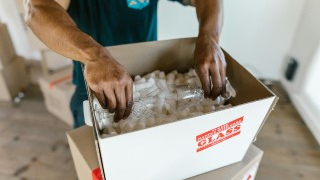
Stemware is the most vulnerable item in your kitchen. Use a cellular divider inside a dish pack for the best results. Wrap the stem first with bubble wrap or several layers of paper to thicken it and make it as wide as the bowl of the glass. Then, wrap the entire glass. Place them in the box rim-down or rim-up - never on their sides. Fill every empty gap in the divider with crumpled paper so the glass cannot move at all.
Packing Pots and Pans
Pots and pans are durable but bulky. The goal here is to save space.
- Large Pots: nest smaller pots inside larger ones, placing a layer of paper between them to prevent scratching;
- Lids: wrap glass lids in bubble wrap. You can often flip them upside down on the pot they belong to, then tape them down (using painter's tape to avoid residue) and wrap the entire unit;
- Nonstick and Cast Iron Care: use extra padding for nonstick surfaces to prevent gouges. For cast iron, wrap them individually in heavy paper; these are very heavy, so put them at the very bottom of medium-sized boxes.
Packing Cutlery and Utensils
Cutlery is heavy and can be sharp. Do not just toss it into a loose box.
- Knives: wrap each knife individually in several layers of packing paper or bubble wrap. For extra safety, wrap them in a kitchen towel and then secure the bundle with tape. Always point the blades in the same direction and mark the bundle clearly as "SHARP KNIVES";
- Forks, Spoons, Spatulas, Ladles: group these by size and use rubber bands or plastic wrap to keep them together. You can leave them in their tray if it fits into a box, but wrap the entire tray in stretch wrap to keep items from flying out.
Packing Oddly Shaped or Oversized Items
Items like rolling pins, cooling racks, and colanders don't fit well in standard stacks. Use these items to fill the gaps in boxes filled with larger, heavier items. Wrap them in paper to prevent them from scratching other surfaces.
How To Pack Kitchen Appliances for Moving
Appliances are expensive and often contain delicate electronic components or glass parts. Proper preparation is essential.
Preparing Appliances Before Packing
Clean every appliance thoroughly. Crumbs in a toaster or grease in a microwave can become messy or attract pests during storage. Unplug all devices and secure the cords. You can tape the cord to the back of the appliance using painter's tape to ensure it doesn't dangle and cause a trip hazard. If an appliance has removable parts (like the glass tray in a microwave), remove them and wrap them separately.
How To Pack Small Kitchen Appliances
If you have the original boxes for your coffee maker, toaster, or blender, use them. They were designed specifically for that item's dimensions. If not, use a medium box. Pad the bottom of the box, place the appliance inside, and fill all surrounding gaps with packing paper. The appliance should not move when you shake the box gently.
How To Pack Large Kitchen Appliances
For refrigerators, ovens, and dishwashers, the process starts 24-48 hours before the move:
- fridge: defrost the freezer and wipe it dry to prevent mold;
- oven: remove the racks and wrap them separately;
- dishwasher: disconnect the hoses and ensure all water is drained;
- secure all doors with professional-grade moving straps or specialized tape that won't damage the finish.
Where NOT To Pack Appliances
Never pack appliances in boxes that are too large. This allows them to slide around, which can damage the internal mechanisms. Also, avoid packing them with heavy, solid items like canned goods, which could crush the appliance's exterior casing.

Box Packing Rules Every Mover Should Follow
To ensure your boxes make it through the move without collapsing or breaking the items inside, follow these golden rules of professional packing.
Heavy Items on the Bottom
This is a fundamental rule of physics. Canned goods, cast iron pans, and heavy mixing bowls should always go at the bottom of the box. This creates a stable base and prevents lighter, more fragile items from being crushed.
Wrap Every Breakable Individually
Never let two pieces of glass or ceramic touch each other. Even a small vibration during transit can cause "clinking," which leads to hairline fractures or total breakage. Each item needs its own "buffer zone" of paper or bubble wrap.
Don't Overload Boxes
It is tempting to fill a large box with all your heavy plates, but you won't be able to lift it, and the bottom of the box might give way. A good rule of thumb is that no box should exceed 30-40 pounds. If a box feels too heavy, redistribute the contents.
Fill Empty Space to Prevent Shifting
A half-empty box is a dangerous box. Items will shift, and the box itself is more likely to be crushed when stacked. Use "void fill" - crumpled paper, towels, or even rolls of paper towels - to fill every square inch of the box until there is no movement when you close the lids.
How To Label Kitchen Boxes Like a Pro
Label at least two sides of every box. Include the room ("KITCHEN"), the contents, and its priority. If a box contains your daily coffee maker and mugs, mark it "KITCHEN - PRIORITY 1." This ensures that when you arrive at your new home, you know exactly which boxes to open first.
Moveshire's Top Kitchen Moving Tips
With years of experience in the moving industry, Moveshire has developed several "insider" tips to make your kitchen move even smoother.
Tip #1: Pack a "First Night" Kitchen Box
Moving is exhausting, and the last thing you want to do is hunt for a fork. Your "First Night" box should contain coffee, a French press or small coffee maker, snacks, basic cleaners, a few plates, and maybe a bottle of wine and a corkscrew. Keep this in your personal car so it is immediately accessible.
Tip #2: Use Linens and Towels as Free Padding
Don't waste money and space packing your kitchen towels and oven mitts in their own box. Use them to wrap fragile items or to fill gaps in boxes. This serves two purposes: it protects your dishes and saves space elsewhere.
Tip #3: Photograph Appliance Setups Before Disassembly
If you have a complex espresso machine or a refrigerator with a water line, take a photo of the connections before you unplug everything. This will be a lifesaver when you are trying to set everything back up in your new kitchen while tired and stressed.
Tip #4: Plan Your Moving Budget in Advance
Kitchen moves often involve specialty materials like dish barrels and bubble wrap that add up quickly. Before you start buying supplies, take the time to build a realistic estimate using our guide on creating a realistic moving budget so there are no surprises on moving day.
Tip #5: Consider Hiring Moveshire's Professional Packers
If the thought of wrapping every single spoon and plate is overwhelming, consider hiring professionals. Moveshire offers specialized packing services where trained experts can pack your entire kitchen in a fraction of the time it would take you, using professional-grade materials that guarantee the safety of your items.
Ready To Move? Let Moveshire Handle the Heavy Lifting
Packing your kitchen doesn't have to be a nightmare. By following this guide, you can ensure that your plates stay intact, your appliances remain functional, and your stress levels stay low. However, we know that life is busy. If you would rather spend your time planning your new home's decor than wrapping hundreds of forks, Moveshire is here to help.
Our professional moving teams are experts in kitchen logistics. Whether you are planning an apartment move, a full house move, or a residential relocation of any size, we provide top-tier packing materials, secure transportation, and the muscle needed to move even the heaviest appliances. Need to move just a few items? Our small movers service is a flexible, affordable option. Whether you need a full-service move or just help with the fragile kitchenware, we have a solution that fits your needs. Contact Moveshire today for a free quote and let us take the weight off your shoulders.
Frequently Asked Questions About Packing a Kitchen for Moving
How far in advance should I pack my kitchen?
You should start the process about 4-6 weeks before moving by decluttering and packing non-essentials. The bulk of the packing should happen 1 week before the move.
Can I pack my kitchen the night before moving?
While possible for a very small studio, it is not recommended for a full kitchen. The kitchen takes longer than any other room due to the fragile nature of the items. You will likely become frustrated and start cutting corners on safety.
What is the safest way to pack dishes?
The safest way is to use double-walled dish barrel boxes and pack the plates vertically on their edges. This allows the plates to withstand more pressure and movement without cracking.
How do I pack wine glasses without breaking them?
Use cardboard dividers and wrap the stems extra thick with paper to reinforce them. Always pack wine glasses in the upright position and never lay them on their sides.
Should I pack my kitchen myself or hire movers?
If you have a lot of high-value, fragile items or a very large kitchen, hiring movers can save you time and provide peace of mind through insurance coverage. If you are on a budget, you can pack the sturdy items yourself and hire professionals just for the breakables — Moveshire's professional packing services offer flexible options for exactly this scenario.
How many boxes does a kitchen take to pack?
A standard kitchen usually requires between 20-40 boxes of various sizes. This includes a mix of small boxes for heavy items and specialized dish packs for fragile ones. Read our detailed breakdown of small vs. large moving boxes to help you plan the right quantities.